
Why Self-Regulation Is the Foundation of Mental Performance for Athletes
The Skill Beneath Every Mental Skill
When athletes struggle under pressure, the response is usually the same:
Work on confidence.
Improve focus.
Get mentally tougher.
But those skills don’t exist in isolation.
They sit on top of something more fundamental — something that determines whether they’re even accessible in the moment.
That skill is self-regulation.
The Assumption: Mental Skills Are Independent
Mental skills are often taught as separate tools:
confidence
focus
resilience
composure
Train one. Add another. Stack them over time.
The problem is that under pressure, skills don’t fail randomly.They fail together.
Confidence drops.
Focus narrows or scatters.
Decision-making slows.
That’s not a skills issue.
It’s a regulation issue.
What Actually Happens When Pressure Rises
Under pressure, the nervous system shifts state.
Breath changes.
Muscle tone changes.
Attention narrows or becomes rigid.
Interpretation speeds up.
When regulation is low, the system becomes:
reactive instead of responsive
effortful instead of efficient
tight instead of adaptable
At that point, it doesn’t matter how many mental skills someone has practiced.
They can’t access them.
This is what athletes mean when they say:
“I know what to do — I just can’t do it.”
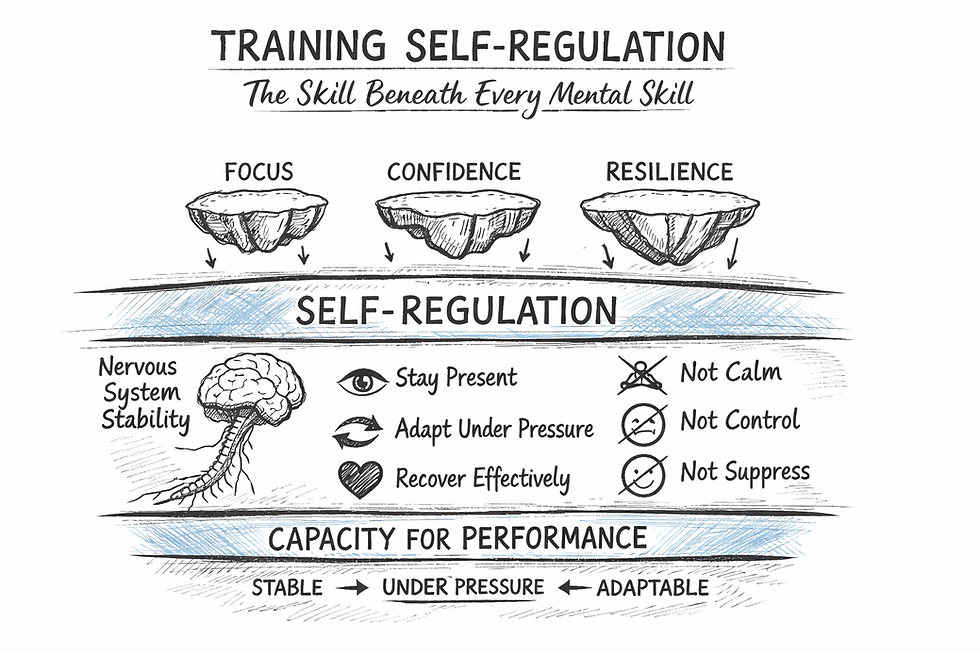
What Self-Regulation Really Is (And Isn’t)
Self-regulation is often misunderstood.
It is not:
staying calm all the time
controlling emotions
suppressing nerves
eliminating intensity
Self-regulation is the system’s ability to:
tolerate activation without tipping into overwhelm
return toward baseline after stress
stay present while intensity rises
adapt when conditions change
In other words, it’s capacity under pressure.
A regulated system can move up and down the intensity range without losing access to skill.
Why Elite Athletes Train Regulation on Good Days
One of the biggest misconceptions is that regulation is only for moments of struggle.
Elite athletes don’t wait until things fall apart.
They train regulation when:
performance is steady
confidence is intact
pressure is manageable
Why?
Because regulation isn’t built in crisis .It’s built through repetition when the system is stable enough to learn.
That’s what allows regulation to hold when pressure increases.
By the time stress is high, the work has already been done.
How Regulation Is Trained (Without Turning It Into a Routine)
Regulation isn’t trained through rigid protocols.
It’s trained through integration:
breath awareness
attention flexibility
body sensing
interpretation under load
Not as separate drills — but as coordinated skills.
This is why forcing relaxation rarely works.
The goal isn’t to calm the system down.The goal is to expand the system’s range so it can stay online at different intensities.
That’s what stability under pressure actually looks like.
What “Stable Under Pressure” Really Means
Stability doesn’t mean nothing moves.
It means:
emotions can rise without hijacking decisions
mistakes don’t spiral into overcorrection
focus can widen or narrow as needed
effort doesn’t turn into force
Stable athletes still feel pressure.
They just aren’t controlled by it.
That’s the difference regulation makes.
Why This Skill Sits Beneath Everything Else
Confidence depends on access.Focus depends on state.Resilience depends on recovery.
Self-regulation is what allows all of them to function — especially when conditions aren’t ideal.
Without it, mental skills become situational.
With it, they become reliable.
That’s why this work isn’t an add-on.
It’s the base layer.
If you’re interested in learning how self-regulation is trained — not as a concept, but as a practical skill that supports performance under pressure — you’re welcome to book a call to explore the approach.
Kate
About: Kate Allgood is educated in the field of applied sport psychology. She holds two Masters degrees in psychology where she graduated with distinction. After a very successful hockey career, she has spent the past 14 years working one on one with high school, college, Olympic, and professional athletes to help them with their mindset, mental performance and mental skills training. Kate has also been a consultant for professional teams, including the Anaheim Ducks primary minor league affiliate the San Diego Gulls, to help the team and players develop their mental game. It is important to note that while Kate has graduate school training in applied sport psychology and general psychology, she does not diagnose or treat clinical disorders, and is not a licensed psychologist.
**The information provided is not to dispense medical advice or prescribe the use of any technique, either directly or indirectly, as a form of treatment for physical, emotional, or medical problems, without the advice of a physician. The information provided is only to offer information of a general nature to help you in your quest for high performance. If you know or suspect you have a health problem, it is recommended you seek your physician's advice.
Frequently Asked Questions
What does self-regulation mean in performance training?
Self-regulation refers to the system’s ability to stay stable, adaptable, and present under pressure. It’s not about staying calm or controlling emotions, but about maintaining access to awareness and choice as demands increase.
Is self-regulation the same as mental toughness?
No. Mental toughness is often associated with pushing through discomfort. Self-regulation is about managing internal state so that effort, focus, and decision-making remain available without forcing or suppressing.
Does self-regulation mean lowering intensity or competitiveness?
No. Self-regulation doesn’t remove intensity — it supports it. A regulated system can move between high activation and recovery more effectively, which allows athletes to compete with intensity without losing stability.
Is self-regulation only important when things go wrong?
No. Self-regulation is most effective when trained on good days. Building this skill when performance is steady allows it to hold under greater pressure later on.
How is self-regulation different from relaxation or stress management?
Relaxation can be one outcome of regulation, but regulation itself is broader. It includes how the body, attention, and interpretation work together under stress, including during high-intensity moments.
Is this approach appropriate for youth athletes?
Yes, when taught in age-appropriate language. For younger athletes, regulation training focuses on awareness, recovery, and responsiveness rather than analysis or control.
Is this therapy or mental health treatment?
No. This work focuses on performance training and skill development. It does not diagnose or treat mental health conditions and is not a substitute for clinical care when that’s needed.
What happens on the call if I book one?
The call is a conversation to explain how self-regulation is trained in a performance context and whether this approach fits your goals and environment. It’s not an assessment or diagnosis.


Comments